
Perspective | Establishing the First Multisensory Learning Space in Bangladesh
At Islamic University bangladesh in Kushtia, a university room is taking on a new purpose. Students will be able to encounter a landscape, listen to a story, share a memory, and use those experiences to explore the world around them. Islamic University is establishing Bangladesh’s first Multisensory Learning Space (MSLS), creating an opportunity to connect inclusive education with community life and the future of our environment.
This work has grown through the Erasmus+ RESHAPE project and exchanges in Finland and Sweden. At Laurea University of Applied Sciences, we encountered the Multisensory Space method and began considering how it could take shape in Bangladesh. The presentation introducing the method helped us see that the space is not simply a room with projections: it is an open learning environment designed through collaboration, experience, inquiry, and participation (Räty, 2026).
An idea that travelled with us
RESHAPE stands for Regenerating Socio-Cultural Sustainability and Planetary Wellbeing in Higher Education: Global Partnership. The project brings together higher education institutions in Finland, Sweden, Bangladesh, and Indonesia during 2026-2028. It gives us opportunities to consider how universities can connect sustainability with the everyday experience of learning.
At Laurea, we learned about the Multisensory Space method, developed since 2007. Its beginnings include a small, memorable encounter. Minttu Räty has described a Somali friend bringing her sand from Mogadishu. Feeling the sand brought him back to memories of home. That experience helped inspire an environment where people could share memories and life stories through sensory encounters (Wikström, 2026).
The story helps explain why the method matters to our work. An object can open a conversation that a formal question might not. An image or sound can connect a classroom topic with someone’s lived experience. The purpose is not to assume that combining senses automatically produces learning. Instead, a carefully created, experience-rich environment can invite curiosity, emotional meaning, dialogue, and motivation to learn (Räty, 2026; Räty & Wikström, 2022).
Turning the idea into a room in Kushtia
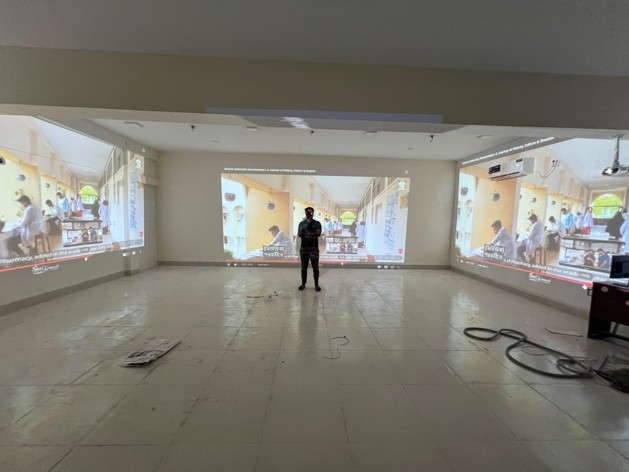
Back at Islamic University, the work became concrete. We cleared and prepared the original room, upgraded the entrance, and installed Epson projection equipment, a dedicated control panel, CCTV, air conditioning, solar panels and associated equipment, and lighting suited to projected imagery. These decisions move us towards an environment where a group can gather and explore a shared theme.
The renovation brought educational and technical responsibilities together. Faculty members, IT personnel, institutional colleagues, and external support all had roles in planning. Equipment needed to work together, while the room needed to support participation. Questions about seating, access, comfort, and facilitation became part of the educational task.
The solar installation also makes energy use visible. Its environmental contribution will depend on how much electricity it supplies and how the space is operated. It gives us a practical starting point for discussing renewable energy, resource use, and the choices a university makes in daily life.
A shared process for designing learning
Räty’s presentation describes the environment as a common project. Its educational foundations include project-based learning, social constructivism, experiential learning, and inquiry-based learning. In practice, participants plan together, learn by doing, ask questions, and use their different perspectives to shape the activity (Räty, 2026).
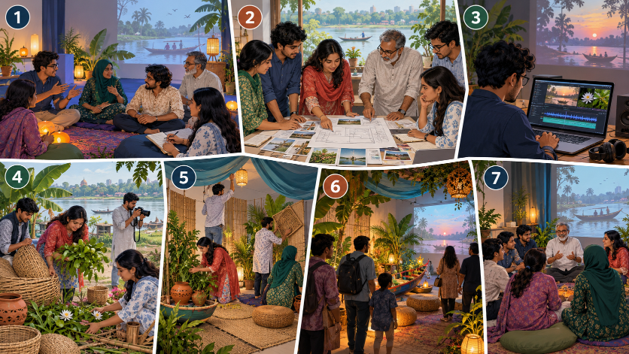
The presentation’s planning sequence can be adapted for an MSLS activity in Bangladesh. The seven stages below translate its meetings, independent preparation, activity day, and feedback session into a practical path. They are a flexible guide: groups can revisit a step or adapt the timing to their theme, participants, and resources.
1. Meet and become familiar. Participants get to know one another, explore the space, and agree how they want to work together.
2. Choose a theme and share ideas. The group brainstorms a topic, identifies questions, and divides responsibilities so that students and facilitators can contribute.
3. Prepare media. Participants gather or create suitable images, video, sound, objects, or other materials linked to the theme.
4. Develop the activity. The group plans how people will experience the materials, what questions will guide discussion, and what learners might investigate.
5. Shape the room. Participants arrange the décor, seating, lighting, and locally meaningful objects, considering comfort and access.
6. Build and welcome visitors. The group sets up the environment, tests the equipment, and then invites learners or community participants to take part.
7. Reflect and report. Participants discuss what worked, what they learned, and what should change; the group records feedback and next steps.
Connecting local questions with planetary wellbeing
The presentation identifies themes that can help groups connect a multisensory activity with planetary wellbeing: planetary boundaries, biodiversity and ecosystems, planetary health, circular economy, sustainable societies, systems thinking, and futures literacy (Räty, 2026). These themes become meaningful when learners can relate them to places, livelihoods, and questions they recognize.
For example, an activity could begin with a projected riverside landscape and relevant sounds. Students might discuss what the river means to people who depend on it. A participant could share a memory of flooding or describe a change in local livelihoods. The group could then connect these experiences with environmental management, disaster preparedness, and evidence about local conditions. This is one possible activity, not a report of an outcome already achieved.
Our Gävle reflections recorded the development and inclusion of two undergraduate courses, Environmental Management in Bangladesh and Disaster Management in Bangladesh. They also identified multisensory pedagogy and simulation, a green campus, and community engagement as directions for further work (Islamic University, 2026a). The MSLS could provide a setting where these priorities meet: community participants contribute knowledge of local conditions, and students examine that knowledge alongside disciplinary concepts and research.
Belonging, wellbeing, and local voices
In Tiina Wikström’s presentation, Asaduzzaman’s contribution described how multisensory spaces could support spirituality, planetary wellbeing, peace, and belonging in Bangladeshi higher education (Wikström, 2026, slides 23-24). Asaduzzaman highlighted that combining natural elements, light, sound, visual materials, digital technology, and culturally meaningful objects could create calm and inclusive environments for reflection, dialogue, creativity, and emotional wellbeing.
These are aims for the space as it develops, not measured outcomes. Students bring their communities, beliefs, memories, and concerns into university life. A learning environment that welcomes those experiences can help connect academic knowledge with responsibilities to one another and to the places people call home. Discussion of spirituality should welcome religious and nonreligious perspectives, without expecting participants to share a particular belief.
Listening to different experiences can help students ask whose needs are affected by a decision and whose knowledge should inform it. For the space to serve Bangladesh, local voices must shape its activities. Bangla and other languages used by participants, familiar cultural objects, community stories, and local environmental questions can all guide the work. As we put it in the presentation: “The concept should be locally adapted, inclusive, voluntary, and developed with active engagement of students and communities.”
Come sit watch feel learn & create
Six guiding words give the vision an everyday form. “Come” is an invitation to enter and feel welcome. “Sit” gives people time to settle, listen, and participate at their own pace, with room for those who prefer to stand or move. “Watch” invites purposeful observation of the images and materials. “Feel” makes space for touch, emotion, and the personal meanings an experience may carry.
“Learn” asks us to move from experience towards understanding. Students can reflect, question assumptions, examine evidence, and apply what they have understood. “Create” gives them a role in shaping what happens next: they might contribute materials, design a themed environment, develop research questions, or propose responses to a community concern.
These are connected invitations, not a fixed sequence that every student must follow. Some may speak readily; others may prefer to observe or reflect quietly. Participation should remain voluntary. Adjustable sensory input, accessible materials, and thoughtful facilitation can help accommodate different needs.
What comes next
As Bangladesh’s first MSLS takes shape at Islamic University, our next task is to make these intentions part of regular educational practice. Faculty preparation, student participation, and community collaboration will determine how the room is used. Student work and participant feedback can help us understand what people learn, whether they feel able to contribute, and which activities need to change.
The room’s continuing story will be written by the people who enter it. A student may bring a question, a teacher may introduce a local problem, or a community participant may share an experience that changes the discussion. We want the MSLS to give those encounters a place in university education, where learning about sustainability grows through shared experience, careful inquiry, and opportunities to create together.
Sources
Islamic University. (2026a, June 9). RESHAPE reflection WP 2 P 06. Gävle, Sweden. Project reflection document cited in the original blog draft.
Islamic University. (2026b, June 12). Plan the Multisensory Space activity. Laurea, Finland. Project planning document cited in the original blog draft.
Räty, M. (2026, October 12). Introduction to Multisensory Space Method [Presentation]. Laurea University of Applied Sciences. Presentation supplied for this revision.
Räty, M., & Wikström, T. (2022). Multisensory Space Handbook. Laurea University of Applied Sciences. https://urn.fi/URN:ISBN:978-951-799-644-0
Wikström, T. (2026, September 21). Multisensory Space Supporting Spirituality and Fearless Belonging in Higher Education [Presentation]. The quotations attributed to Md. Asaduzzaman, Islamic University, Bangladesh, appear on slides 23-24; the account of Minttu Räty and the sand from Mogadishu appears on slide 8.
Acknowledgement:
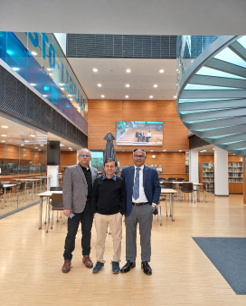
We would like to express our sincere gratitude to Md. Salahuddin and his team, IT Specialist, for his tireless efforts and dedication to establishing the MSLS at IUB. His continued commitment and hard work are helping to build a strong foundation for the program and support its development.
Authors:
- Mohammed Asaduzzaman, PhD, Professor, Department of Public Administration, Islamic University (IU) in Kushtia, Bangladesh.
- Mohammad Zulfiquar Hossain, PhD, Professor, Department of Public Administration, Islamic University (IU) in Kushtia, Bangladesh.
- AKM Motinur Rahman, PhD, Professor, Department of Public Administration, Vice-Chancellor, Islamic University (IU) in Kushtia, Bangladesh.